|
Reading the new
food labels |
By January, 2006
all packaged food products sold in the United
States must have nutrition labels that include
information about the trans fat content. While
many companies area already modifying their
labels, other food manufacturers are scampering
to update their product packaging.
The new labels
will help consumers track the amount of
trans
fat they are actually eating. Right now, it is
nearly impossible for average people who eat a
lot of processed foods to calculate the trans
fatty acids that are in their diets.
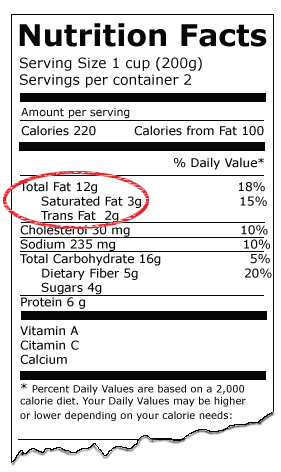
Remember that the
information on each nutrition label is
calculated per serving. So, it is
critical to check the serving size and compare
it to the amount of the food you actually eat.
Each label will
indicate the total number of fat grams (marked
"Total Fat") as well as the amount of that fat
that is saturated fat and the amount that is
classified as trans fat. There is no % daily
value indicated for trans fat since the FDA does
not recommend that people actually consume trans
fats; nutritionally they offer no benefits.
So, what do you
want to look for? The lower the number of grams
of both trans fats and saturated fats, the
better the food is for your health. A zero in
each category probably means the fats in the
food are fairly healthy. A product that is
labeled zero grams of fat per serving may still
contain up to .5 grams of fat per serving; at
this amount, the FDA allows the manufacturer to
claim the trans fat content is zero.
Even if the food
does not have saturated or trans fats, it is
still important to watch the total number of fat
grams. While unsaturated fats, such as extra
virgin olive oil, are far better than saturated
or trans fats, fat contains more calories per
gram than foods such as protein or
carbohydrates. A healthy diet requires a balance
of different foods and nutrition experts
generally recommend less than 30% of each
person's diet come from fat calories.
Learn more about trans
fat labeling...
|